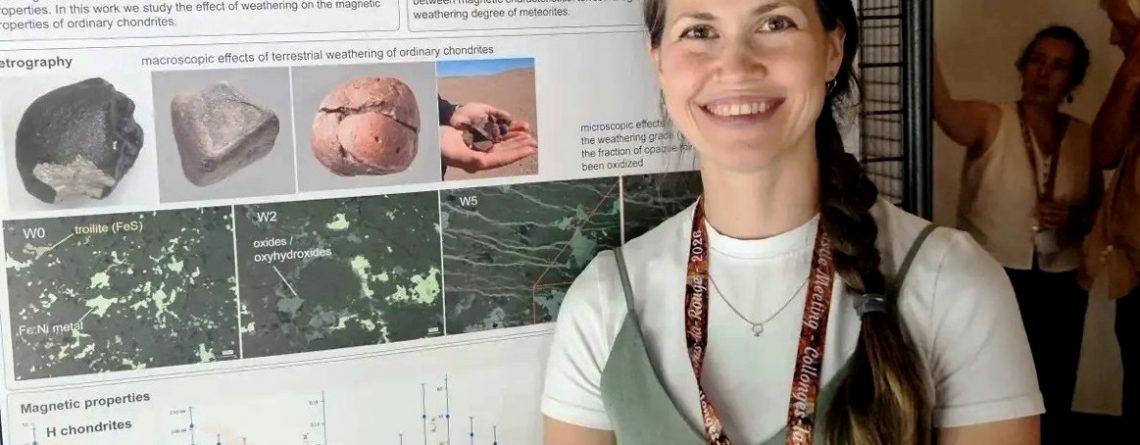
Dilyara Kuzina informs about developments in studies of Atacama desert meteorites at 19th Castle Meeting – New Trends in Rock, Paleo and Environmental Magnetism
A report titled Evolution of the Magnetic Properties of Meteorites Over Time: Evidence from Atacama Desert Meteorites was presented by her in Collonges-la-Rouge, France.
The international conference brought together scientists from China, India, Russia, Australia, Brazil, and European countries. Presenting her poster, Dr Kuzina explained how the magnetic properties of meteorites change after prolonged exposure to the Earth’s environment and how accurately these properties can be used to determine their terrestrial age.
“The conference covered a wide range of topics in rock magnetism and paleomagnetism, from plate tectonics to the study of meteorites, environmental changes, and paleoclimatology,” said the employee of the Laboratory of Generation, Storage, and Transportation of Hydrogen and Low-Carbon Energy Carriers. “I presented the results of studies on 117 meteorites collected in the Atacama Desert. The work was carried out in 2024 – 2025 at Kazan Federal University under my supervision as part of the project Weathering of Meteorites from the Atacama Desert: Assessment Using Magnetic Methods, supported by a grant from the Russian Science Foundation. The research was later continued in collaboration with French colleagues from the European Center for Research and Education in Geosciences and the Environment, who provided most of the samples for analysis. Meteorites from the collection of the Vernadsky Institute of Geochemistry and Analytical Chemistry of the Russian Academy of Sciences were also studied.”
According to Dilyara Kuzina, a pattern was identified using a combination of petromagnetic methods: as the degree of weathering increases, magnetic susceptibility and saturation magnetization decrease.
“In meteorites, the primary magnetic minerals are iron – nickel alloys, which have high magnetic susceptibility,” the scientist explained. “On Earth, these alloys gradually oxidize, transforming into oxides and hydroxides, which weakens the meteorite’s magnetic properties. Our goal was to determine whether magnetic characteristics could serve as a kind of ‘magnetic clock’ to estimate terrestrial age. The correlation we identified between magnetic properties and terrestrial age turned out to be insufficiently strong: at present, we can only roughly determine which meteorite is older and which is younger.”
In addition to the scientific program, a cultural program was prepared for conference participants.
“We had the opportunity to see a reconstruction of the Lascaux Cave – a precise replica of part of the original underground complex with prehistoric cave paintings. The real Lascaux Cave has been closed to visitors since 1963 to preserve its unique prehistoric artwork,” Kuzina shared.
The Castle Meeting format emphasizes informal communication among scientists working in rock magnetism, paleomagnetism, and environmental magnetism.