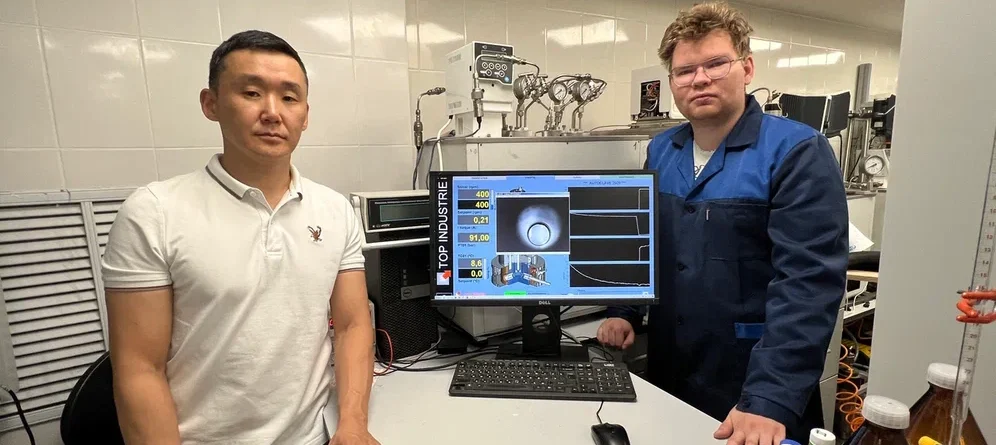
KFU uses in-house lab complex for gas extraction from gas hydrate pellets
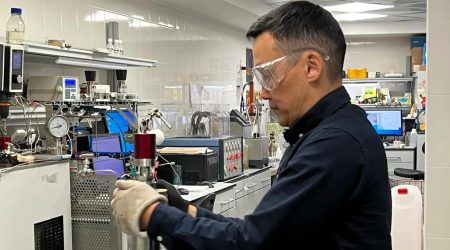
The Laboratory of Hydrate Technologies for Greenhouse Gas Storage and Utilization has developed a laboratory complex that can produce, press, and test gas hydrates, as well as manage the process of gas extraction from them.
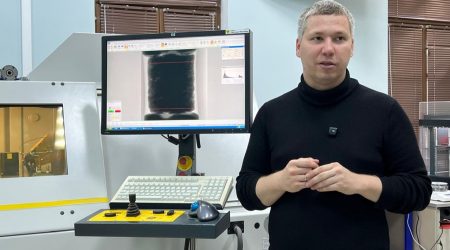
Ahead of Inventor and Innovator Day, celebrated on June 27, we spoke with the creator of this scientific complex, Matvey Semyonov, a leading researcher at the laboratory.
He noted that in 2024, the laboratory’s staff, together with colleagues from the Institute of Inorganic Chemistry and Gubkin University, invented the first Russian complex for the rapid production and pressing of gas hydrates. Based on this complex, he created his own laboratory complex in 2026.
“Gas hydrates resemble snow in appearance, but differ in that the ‘cages’ of water molecules contain molecules of natural gas or associated petroleum gas, rather than air. One volume of this material holds approximately 160 volumes of gas and, in moderate cold, does not melt, remaining stable for a considerable time. This is the basis for the idea of storing and transporting natural and associated petroleum gas in the form of solid pellets,” explained Semyonov.
The scientist explained the uniqueness of the laboratory setup he created.
“We are researching substances that accelerate hydrate formation. For example, my colleagues and I recently compared the effectiveness of classic industrial sodium dodecyl sulfate (SDS) and a biosurfactant based on renewable castor oil (CS). We conducted an experiment. We produced pellets, one using SDS and the other using CS. We monitored the state of each pellet for 100 hours to prove their long-term stability. The trends were clear and consistent, but single measurements are not enough for rigorous statistical analysis. The main feature of the laboratory setup is four autoclaves operating in parallel. The new setup allows us not only to record how long four pellets remain stable but also to observe how they release gas during regasification—the controlled release of gas.”
He noted that different conditions can be created in each autoclave by varying the pressure and temperature. This means that all the necessary data can be obtained in just one experiment. Previously, this required several experiments. According to Semyonov, his setup allows for gas sampling during regasification to monitor its composition.
“This is especially important for associated petroleum gas: it is multicomponent, and different hydrocarbons are retained in the hydrate at different rates. Methane, ethane, propane, and heavier fractions can be released unevenly over time. The ability to collect and analyze samples allows us to track how the composition changes during the decomposition process and assess the final quality of the gas delivered to the consumer,” he explained.
By varying the pressure and temperature in the autoclaves, Semyonov continued, it’s possible to simulate situations that might occur with pellets in real life during storage and transportation. When transporting cargo over long distances, temperature and pressure fluctuate.
According to the leading researcher, the setup he created can be used to study the self-preservation effect of gas hydrates—the ability to slow their own decomposition by forming a protective ice crust on the surface.
“This effect has long been known, but it’s difficult to predict for large pellets and during long-term storage. The new setup will allow us to study it systematically: how the decomposition mode, pellet density, and promoter type affect the amount of gas that can be delivered to the consumer without loss,” the researcher explained.
He added that the scientists will need to determine the safest pressure and temperature for storing and transporting hydrate pellets, as well as develop an optimal pellet regasification scenario, and much more.
“The launch of a four-autoclave complex is a step beyond laboratory screening to data that can be used to design real-world storage and transportation systems for associated gas regasification. This gas is currently flared at oil fields, but it can be collected, frozen as a hydrate, and delivered where needed,” the inventor concluded.