KFU scientists continue inquiries into promoter properties of castor oil
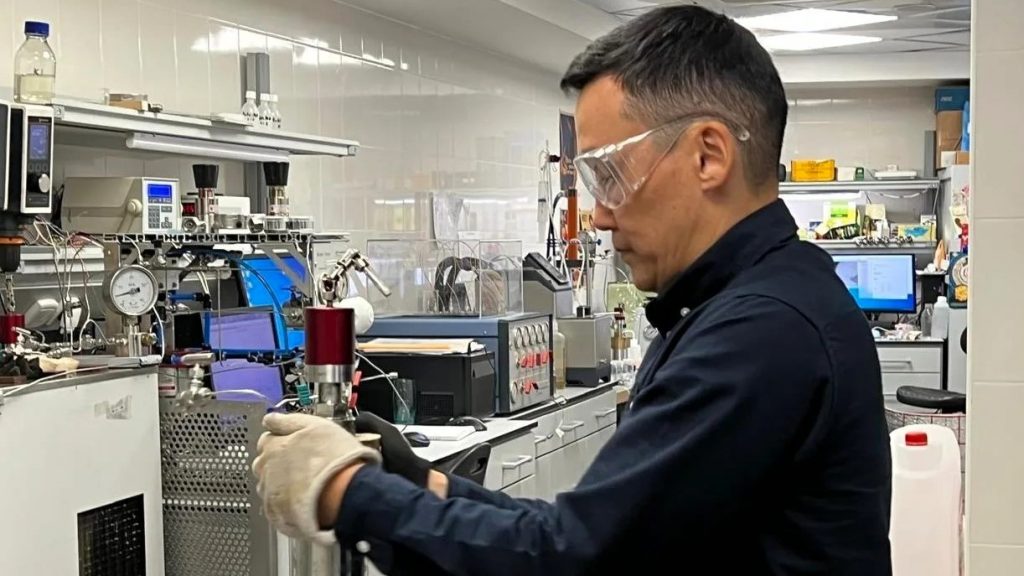
A castor oil-based biopromoter developed by researchers at the Laboratory of Hydrate Technologies for Greenhouse Gas Utilization and Storage at the Institute of Geology and Petroleum Technologies allows for the long-term stabilization of associated petroleum gas hydrate granules.
“Billions of cubic meters of associated petroleum gas are flared annually in oil-producing regions – this is both a loss of valuable raw material and a serious environmental problem. Transporting this gas through conventional pipelines, in liquefied or compressed form, is not always feasible. Therefore, for several decades, scientists around the world have been developing an alternative – a technology for storing gas in the form of gas hydrates,” explains Lead Research Associate Matvey Semyonov. “These are solid crystals, similar to snow or ice, in which gas molecules are ‘packed’ into ‘cages’ of water molecules. One volume of gas hydrate can hold up to 160 volumes of regular methane. Moreover, in hydrate form, the gas is not explosive.”
For gas hydrate technology to become widespread, according to Semoynov, two key issues must be addressed: the gas must quickly transform into a solid state and remain in that state for a long time under specific temperature conditions.
“To accelerate the formation of gas hydrates, surfactants, i. e. promoters, are added to water. For decades, SDS (sodium dodecyl sulfate), a common synthetic surfactant, has been used for this purpose. It accelerates the process, but forms loose hydrate granules from which the gas quickly evaporates, and when they ‘melt,’ a lot of foam forms. SDS does not decompose well in nature,” the scientist adds. “The biopromoter, based on castor oil, developed at Kazan Federal University to intensify the hydrate formation process was chemically modified by the addition of carboxyl and sulfonate groups.”
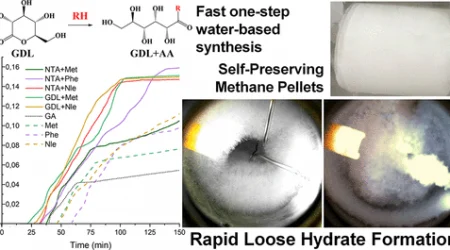
The laboratory staff conducted complex experiments. A biopromoter was used to ‘package’ associated petroleum gas into ‘snow’ pellets at pressures ranging from 5 to 9 MPa. The results of these experiments are presented in a paper published in the journal Energy & Fuels.
“The castor oil biopromoter has three advantages that are important for industrial applications. First, the pellets are stored longer and lose less gas. Second, the absence of foam greatly simplifies gas extraction from the hydrate; persistent foam is a serious problem in large-scale production. Third, castor oil is a renewable raw material, biodegradable, and much less toxic than SDS,” says Matvey Semyonov.
He noted that sodium dodecyl sulfate also has the advantage of forming hydrate in 20 minutes, while the castor oil-based biopromoter does so in 100 minutes under static conditions.
“I would like to emphasize that under dynamic mixing, the biopromoter shows a conversion of 97 percent, higher than that of SDS,” notes the researcher.
According to Lab Technician Ulukbek Mirzakimov, environmental friendliness was the primary requirement for the creators of the castor oil-based promoter, “We chemically modified castor oil to give it surfactant properties. Our toxicity tests of the biopromoter indicate that it is approximately five times less toxic than SDS and is completely biodegradable. It meets modern green chemistry requirements. This is especially important for Russia, where a significant portion of production takes place in environmentally vulnerable regions.”