KFU scientists explored Syrkovy Sor, Yugra’s most mysterious lake

The researchers returned from an expedition to Nefteyugansk District of the Khanty-Mansiysk Autonomous Okrug – Yugra.
“We conducted seismoacoustic studies of bottom sediments to investigate the structure of their layering and the lake’s bottom morphology, and also collected two sediment core columns needed for paleomagnetic and paleoclimatic research,” commented expedition leader Pavel Krylov, Deputy Director for Research at the Institute of Geology and Petroleum Technologies. “The work is being carried out under the mega-grant Global Climate Challenges on the Territory of Russia: Retrospective Analysis, Forecast, and Adaptation Mechanisms, implemented jointly with the Institute of Geography of the Russian Academy of Sciences and other RAS institutes. The data we obtained will help reconstruct the natural conditions of the studied region over the past millennia and assess current geodynamic processes.”
He noted that the body of water is highly unusual. Its diameter is only 1.5 kilometres, yet its depth exceeds 45 metres.
“There is a hypothesis that this freshwater lake is of impact origin — that it formed as a result of a meteorite impact,” said the geophysicist. “Before us, Syrkovy Sor was studied by archaeologists, who discovered a ‘black layer’ in the soil. Geochemical analysis of samples from this layer revealed elevated concentrations of certain elements characteristic of stony meteorites.”
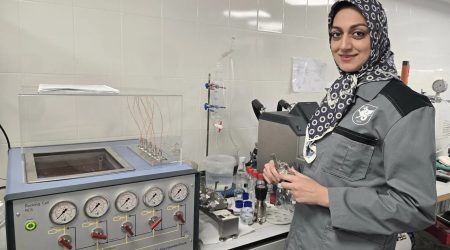
Anastasia Yusupova, Senior Research Associate at the Laboratory for Generation, Storage and Transportation of Hydrogen and Low-Carbon Energy Carriers, who will be tasked with studying the core columns brought back by the expedition team, noted, “The IGPT laboratories will carry out petromagnetic studies of the bottom sediment samples: we will measure magnetic susceptibility and examine them using coercivity spectrometry and differential thermomagnetic analysis. We also plan to determine the granulometric and chemical composition of the samples. The combination of lithological, geochemical, and petromagnetic characteristics will allow us to identify stages with differing sedimentation conditions over the past hundreds of years. Our research aims to study the natural and anthropogenic climate changes that occurred in the past in the vicinity of Syrkovo Sor. This is necessary for creating accurate predictive climate models.”
According to local legend, Syrkovy Sor came into being when three fiery goddesses descended from the sky on an enormous beast. The beast burrowed a deep hole into the ground and fell asleep, after which the resulting crater filled with water.