Laboratory of Industrial Automation opened at KFU in cooperation with Reglab and GKS
The Institute of Geology and Petroleum Technologies held the grand opening on 1st April. It was established by KFU in partnership with Reglab, a Russian equipment manufacturer and software developer for enterprise automation systems, and GKS, an engineering company specializing in the implementation of integrated projects for the oil and gas, petrochemical, and energy industries.
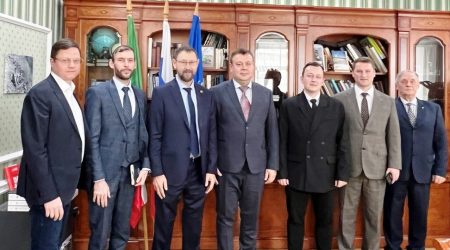
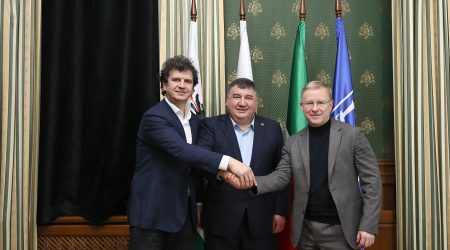
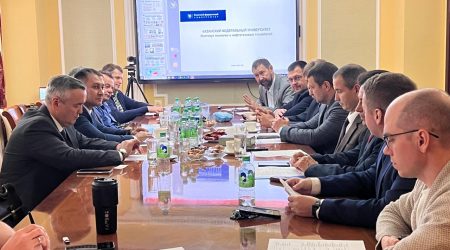
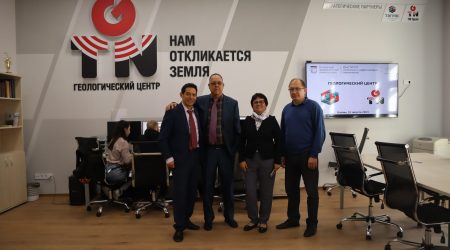
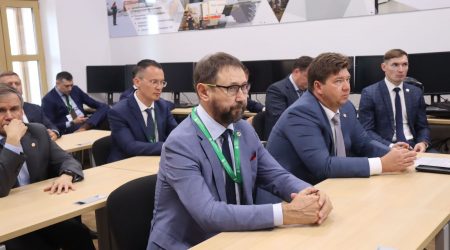
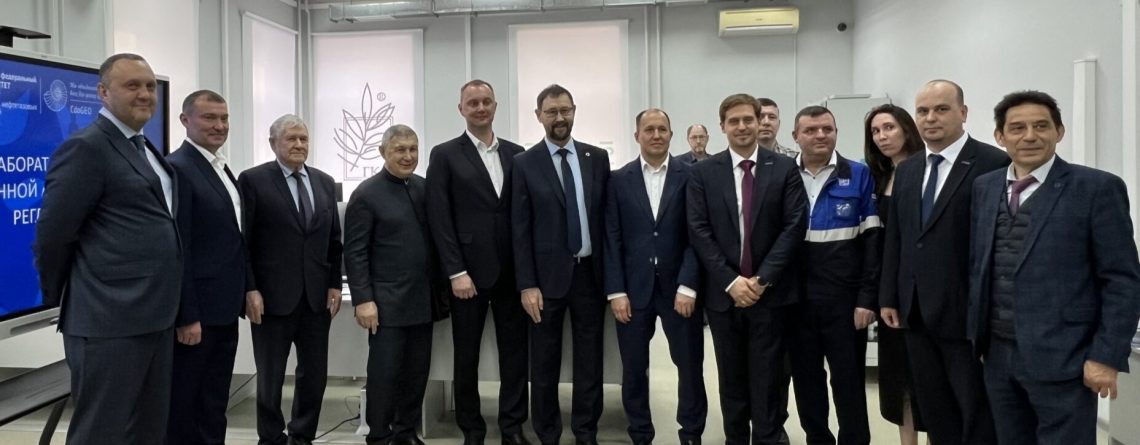
At the ceremony, the laboratory was launched with the press of a Start button. Participants included Rifkat Minnikhanov, President of the Academy of Sciences of the Republic of Tatarstan; Danis Nurgaliev, Vice-Rector for Earth Sciences of KFU; Airat Sabirov, founder of NPP GKS; Ilya Yumankin, CEO of NPP GKS; Andrey Ulyanov, CEO of REGLAB; Rafinat Yarullin, CEO of Tatarstan Petroleum Chemistry Investment Holding; Ildus Chukmarov, Deputy Director for Continuing Education and Industrial Partnerships at the Institute of Geology and Petroleum Technologies; Rustam Nurgaliev, Head of the Department of Automation Systems and Process Control at Kazan National Research Technological University; and others.
“The oil and gas industry forms the backbone of the economies of Russia and Tatarstan. Today, there are a dozen companies in our country that produce automated process control systems (APCS) devices and software, and it’s not worse, and in some cases even better, than what was previously imported,” said Dr Nurgaliev, opening the event. “In the laboratory, we plan to train students, as well as representatives of the petrochemical industry, in managing the most complex processes at enterprises involved in the production, transportation, and processing of hydrocarbons.”
He added that a center of excellence in APCS and a network of specialized university laboratories are planned to be established at the Academy of Sciences of the Republic of Tatarstan.
In his speech, Rifkat Minnikhanov emphasized that the Academy of Sciences of the Republic of Tatarstan considers it necessary to provide grant support for priority areas of science, education, and technology for the republic. These include automation of technological processes in the field of petrochemicals. R. Yarullin stated that early in his career, he worked with automated process control systems and therefore understands their importance for the modern petrochemical industry.
Mr Ulyanov noted in his commentary that the new industrial automation laboratory is an educational platform where students and engineers can learn to work with modern Russian hardware and software.
“Laboratory work will be conducted here, technological processes will be simulated, and emergency response training will be practiced,” he said. “Such projects are designed to bridge the gap between theory and practice, science and the real economy, and facilitate the graduation of professionals who are ready to work with domestic solutions in production.”
According to Mr Yumankin, the laboratory is a kind of bridge between science and real-world production.
“We created a setup tailored to KFU’s needs; our engineers assembled and tested it. We also assembled an automated process control system cabinet, in which we installed Regul programmable logic controllers, provided by REGLAB,” explained the CEO of GKS. “In the laboratory, students will learn to work with equipment installed at Russia’s largest manufacturing facilities. It is important for us to participate in the training of qualified personnel. This is an investment in the country’s future.”
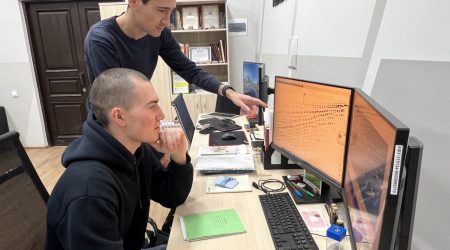
The new laboratory is located at ulitsa Kremlyovskaya 6. It took approximately a year to build. During this time, the facility was renovated, nine computers with specialized software, a laboratory bench, and an automated process control system cabinet were installed.
“Students majoring in petroleum engineering have a course called Fundamentals of Well Automation. Now, in their classes, they will be able to not only study theory but also gain practical skills,” said Ildus Chukmarov. “The Institute of Geology and Petroleum Technologies has several educational laboratories created with funding from industrial partners, including the 3D Geo Center and the interdisciplinary educational Laboratory of Petrophysics and Physics of the Oil Reservoir, which was equipped by Rosneft. The Geophysical Center was created jointly with TNG-Group, the geophysical division of TAGRAS Holding.”
The industrial automation laboratory will be used not only for student training but also for scientific research testing of new control algorithms. Furthermore, engineers from companies working with automated process control systems will be able to improve their skills while taking courses at the Center for Advanced Training.
“We continue our work under our agreements with Kazan Federal University and are creating a unique ecosystem where students are already mastering cutting-edge technologies from REGLAB and GKS. I am confident that this platform will enable us to train world-class professionals who will advance the Russian industry,” noted Mr Sabirov.