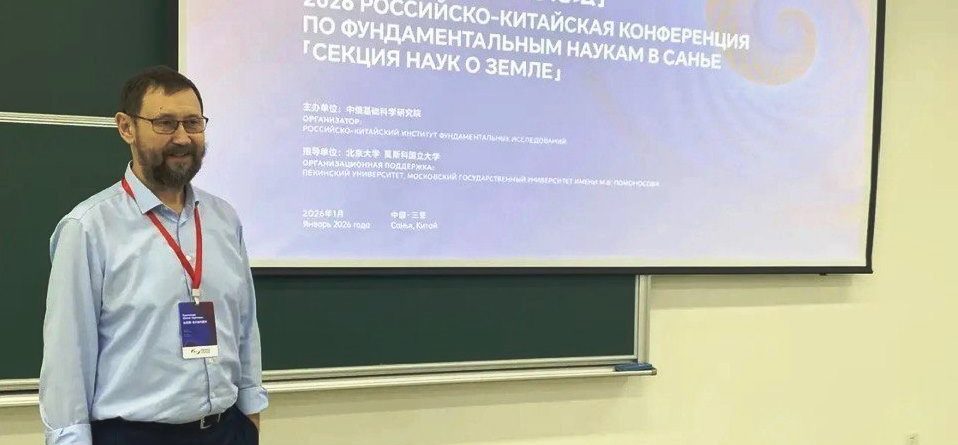
2026 Russia-China Conference of Outstanding Scientists features Vice-Rector for Earth Sciences Danis Nurgaliev
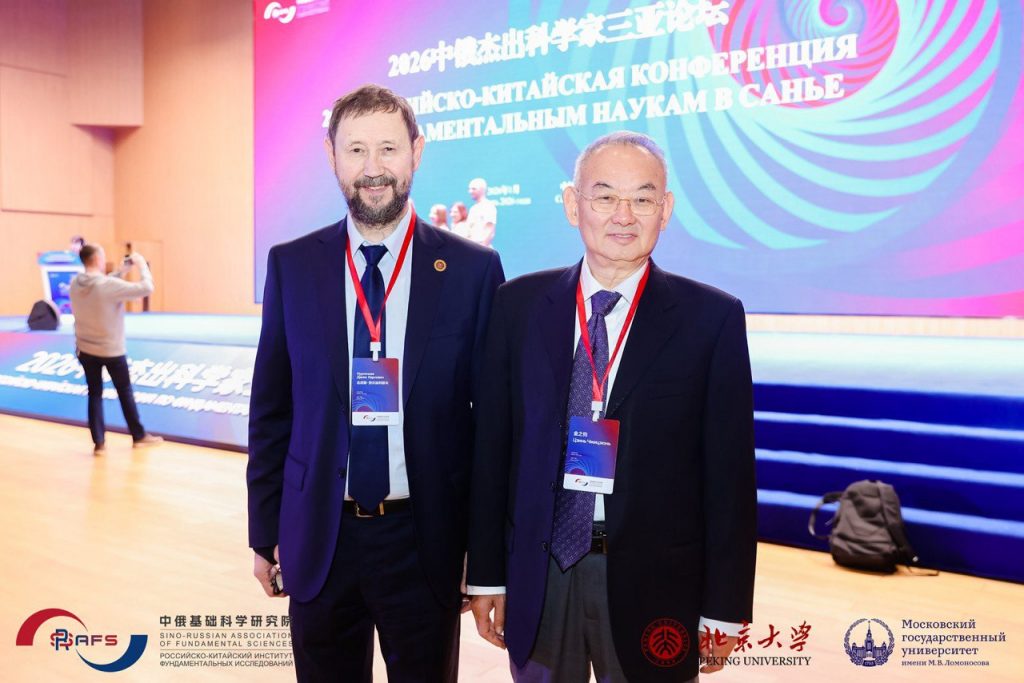
The event took place in Sanya, Hainan Province, from January 30 till February 1.
The event was organized by the Russia-China Institute for Fundamental Research, established in September of last year by Moscow State University and Peking University in accordance with a decision by the leaders of both countries.
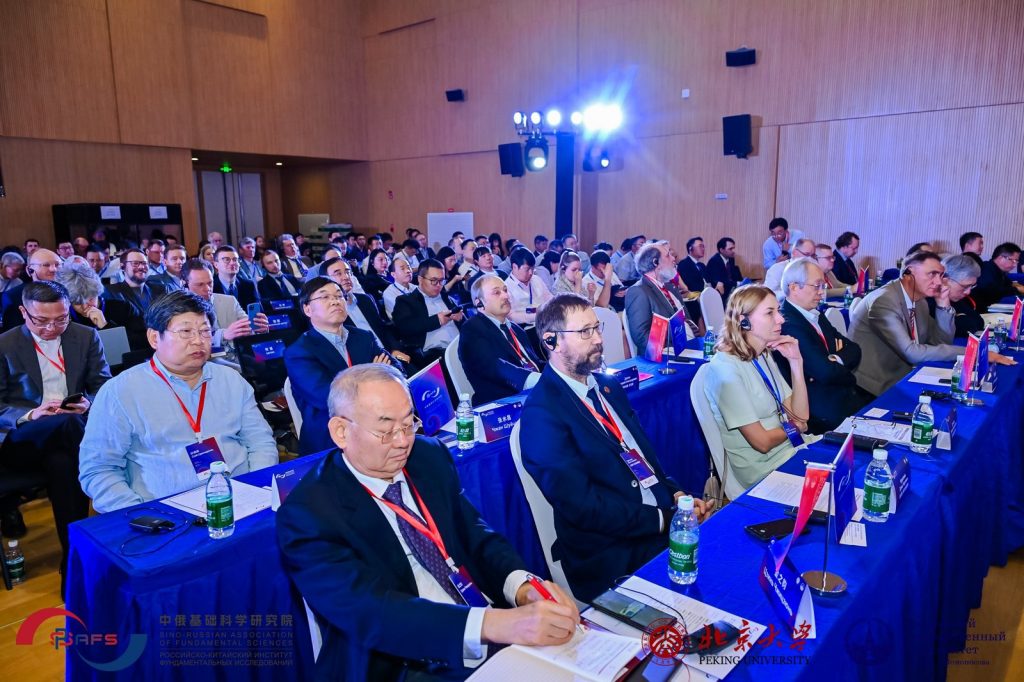
The conference brought together leading scientists and experts from Russia and China, serving as a platform for international scientific dialogue in fundamental sciences, knowledge and experience exchange, and discussion of joint projects.
Conference participants were greeted via video message by Russian Minister of Science and Higher Education Valery Falkov and MSU Rector Viktor Sadovnichy. Peking University President Gong Qihuang participated in the plenary session.
The major scientific event was organized into thematic sections covering areas such as mathematics, physics, chemistry, Earth sciences, and life sciences.
“Russia was represented by universities and academic institutes from Moscow, Kazan, St. Petersburg, Novosibirsk, Yekaterinburg, and Irkutsk. From China, rectors of the country’s largest universities, the president of the National Natural Science Foundation of China, and scientists participated. Speaking at the opening, the head of Peking University noted that Earth sciences are one of the main areas of fundamental research in the world in the near future, because the fate of humanity largely depends on the results of research in these sciences. The main focus at the scientific forum was on ensuring energy and climate security, as well as environmental issues,” says Danis Nurgaliev.
He recalled that in 2024, a memorandum of understanding was signed in Moscow between Peking University, which ranks 14th in the QS world university rankings, and Kazan Federal University, aimed at developing international cooperation in science and education and strengthening contacts between the universities.
“Our interaction dates back to 2017, when Professor Boris Uspensky from the Institute of Geology and Petroleum Technologies first visited Peking University. Director of the Energy Institute at Peking University, Academician Jin Zhijun, with whom we worked in source rock research and development technologies, visited Kazan University twice – in 2018 and 2023. In 2024, we began unique work together with Chinese colleagues on studying rhenium and osmium isotope decay products to determine the age of natural oil components. For many years our staff have been in contact, with mutual visits occurring. And in 2024, Peking University Vice-President Academician Piao Shilong came to KFU, visited laboratories at the Institute of Geology and Petroleum Technologies, the Institute of Environmental Sciences, and showed great interest in cooperation,” continues the vice-rector.
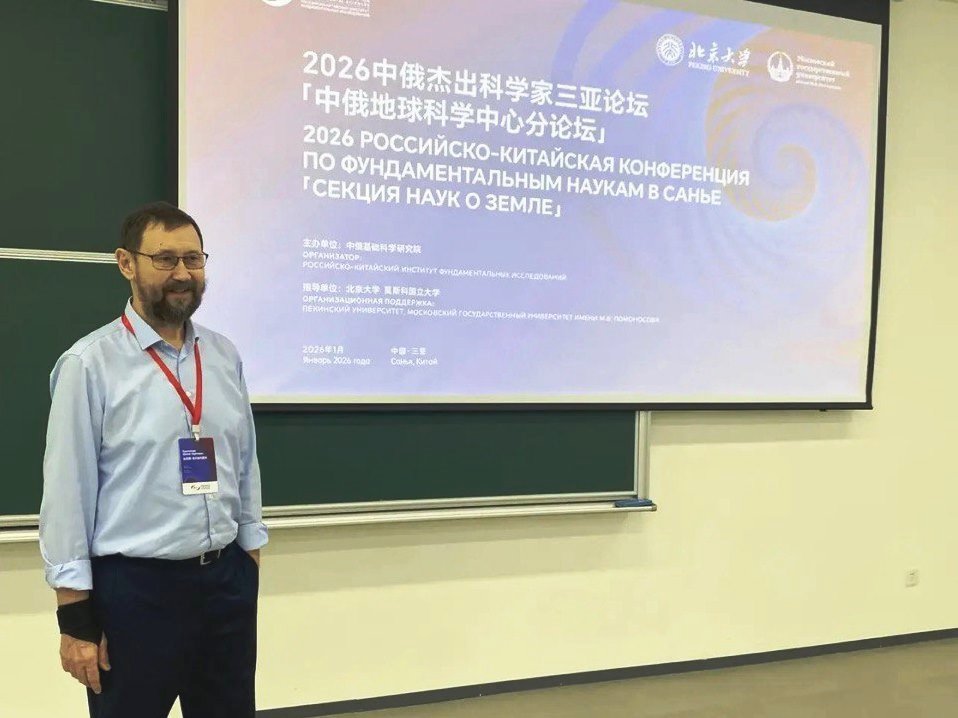
This time, the KFU representative offered two reports at the Earth Sciences breakout session.
“My first report was devoted to natural hydrogen problems, and the second to the use of supercritical water for oil extraction from high-carbon low-permeability rocks,” explains the professor. “Speaking about the section’s work as a whole, I was involved in discussing current issues on four topics. The first is the study of source rocks of the Bazhenov and Domanik formations using modern methods to establish their origin and evolution, and determine territories where oil and gas can be most effectively extracted from these unconventional objects. The second is the use of various methods (in-situ combustion, hydraulic fracturing, supercritical water) for oil extraction from unconventional reservoirs. The third topic concerned natural hydrogen production problems. This area is actively discussed worldwide today, with publications in leading scientific journals growing exponentially. China, Australia, the USA, and some European countries are allocating significant funds for fundamental and applied research in this direction. Our country’s Ministry of Energy and Gazprom show great interest in this issue, and a special program on this topic is being created at the Russian Academy of Sciences. The fourth topic was devoted to environmental issues and the carbon cycle. A comprehensive report on the carbon cycle was presented by Piao Shilong, one of the world’s leading researchers on this issue. During his visit to KFU, he was interested in our research related to monitoring carbon dioxide and other greenhouse gases at our carbon testing site. It’s very pleasant that colleagues from Peking University highly appreciated KFU’s research and proposed cooperation in the mentioned areas.”
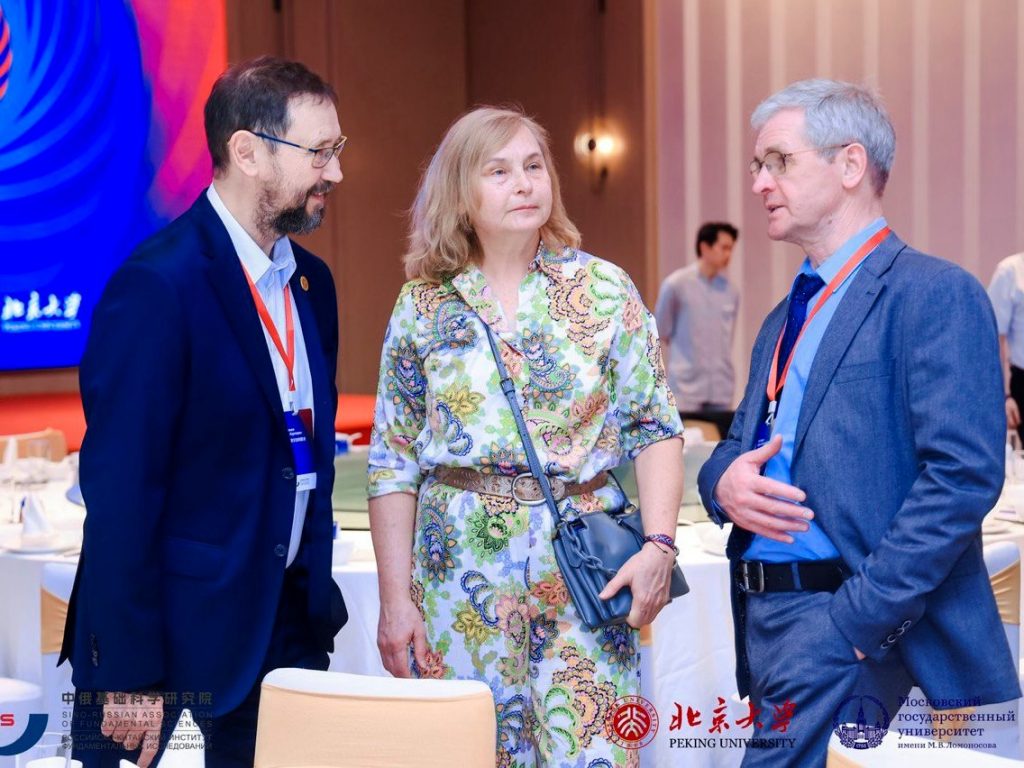
The Vice-Rector added that during the conference, participants discussed not only scientific problems but also issues of interaction between scientists from both countries. Additionally, they were able to visit the Russia-China Institute for Fundamental Research buildings together.
Photos provided by the organizers and Danis Nurgaliev