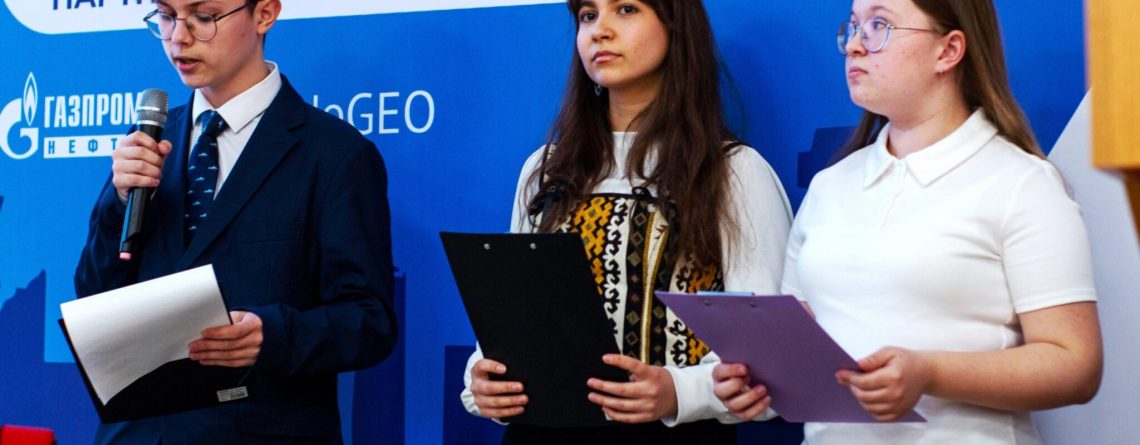
10th Case-UGEO Geological Championship winners determined
The competition focused on global warming and new natural resources of the Arctic.
Students from Russia and the CIS countries were tasked with analyzing the dual impact of global warming on the Arctic: on the one hand, it creates new opportunities for the development of natural resources, while on the other, it creates a host of problems associated with the melting of permafrost. Among the negative consequences of warming are the reduction of Arctic flora and fauna, increased greenhouse gas emissions, and other issues.
This year, the in-person stage of the case championship was held in a hybrid format, significantly expanding the range of participants.
“Fifty-three teams participated in the qualifying round, of which 24 advanced to the in-person round. The final event brought together schoolchildren from several regions. Two teams from CIS countries – Kazakhstan and Kyrgyzstan – also participated,” said Andrey Teryokhin, Deputy Director for Academic Affairs. “The case championship is a special form of intellectual competition. At Case-UGEO, schoolchildren must present their solution to a global problem that currently has no clear solution. This year, the focus was on global warming and the development of the Arctic in this context.”
According to the Deputy Director, the winners and runners-up will receive additional points on their Unified State Exam results in accordance with university admissions regulations.
“The case focused on the emerging opportunities and associated challenges of developing mineral deposits in Russia’s Arctic region in the context of global warming. Each and every team approached the case with remarkable originality,” said Associate Professor Igor Ognev, chairman of the case championship jury. “The participants considered a wide variety of minerals: gold, copper, tin, rare earth metals, and hydrocarbons. The proposed technologies for extracting, processing, and transporting raw materials were equally diverse. These included underwater well mining, the use of nanorobots, the delivery of ore minerals by airships and even ballistic missiles, and the processing and purification of raw materials using bacteria. In addition to their presentations, many teams presented real physical models of deposits and above-ground urban infrastructure for extracting and transporting raw materials to the jury. The idea of building innovative cities like Innopolis in the Arctic deserves special mention. I would like to note that the participants approached the topic comprehensively and responsibly. The teams didn’t limit themselves to developing strategies for the extraction and use of new resources. They also paid serious attention to environmental conservation. The participants proposed specific measures to protect local ecosystems and examined in detail how industrial development in the Arctic can be organized without harming the region’s unique biodiversity. This demonstrates the maturity of the young participants’ thinking and their understanding that responsible subsoil use is inseparable from a respectful attitude toward nature.”
Igor Ognev added that the jury found it extremely difficult to assign places: each decision was excellent in its own way.
“This contest clearly demonstrated the high creative potential of the younger generation. We sincerely hope that many of the participants will choose the profession of geologist in the future and contribute to the development of mineral exploration in our country,” he concluded.
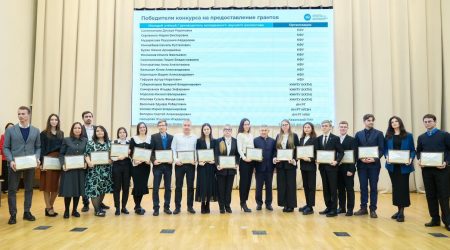
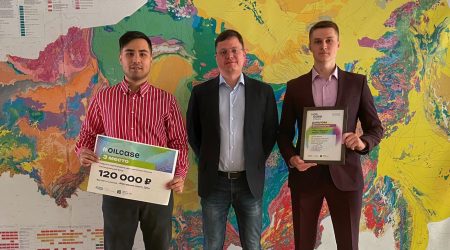
Among the three teams who emerged as winners, two represented Tatarstan and one – Yamalo-Nenets Autonomous Okrug.