On 60th celebration of Geologist Day in Russia, scientists explain how the science has changed during the decades
This professional holiday was established in 1966.
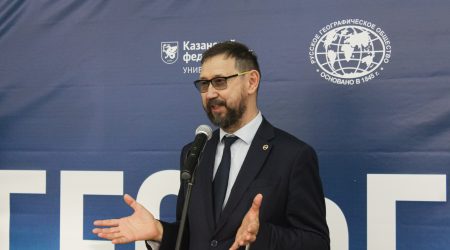
“Geology has undergone colossal changes. In the 1960s, firstly, the technologies we have today didn’t exist, and secondly, geology faced completely different challenges,” says Danis Nurgaliev, Vice-Rector for Earth Sciences. “Russia’s vast territory was still poorly explored. At that time, a 200,000 survey (a geological survey at a scale of 1:200,000) was conducted. Our country had vast territories untouched by humankind. Back then, geology was embraced by romantics who wanted to explore uncharted places. Now, there are no such blank spots on the map of Russia. Space images reveal a lot, and aerial photography allows for photographs with a resolution of several centimeters. The only problem is that geological samples can’t be retrieved from an airplane. They require an expedition. And although the modern geologist sets out on a mission with a thorough knowledge of the area, the romance hasn’t gone away. There are still plenty of accidental discoveries today. Here’s a famous example: geologists were searching for gold in a river, where they expected it to be, but found none. Suddenly, one of them walked up to a nearby stream and discovered gold there. You can accidentally step on a stone, then pick it up and make a discovery. Where else could such a thing be possible except in geology?”
Geological science, according to Dr Nurgaliev, has changed 60 years later.
“Now the mission of geology is not only the search for minerals but also a detailed study of geological history. It’s necessary to know what happened in the past to understand what might happen in the future,” continues the interviewee. “Geology analyzes events that occurred on Earth millions, tens, and hundreds of millions of years ago and their consequences, and, based on this data, predicts the conditions humanity will live in: what will happen to the magnetic field, fresh water, volcanoes, earthquakes, and much more.”
For more accurate forecasts, a more comprehensive knowledge of our planet’s distant past is needed than we currently possess, according to the geophysicist.
In the future, Danis Nurgaliev opines, scientists will create a computer model of all processes occurring on Earth – both natural and anthropogenic. This will help determine how humanity should ‘communicate’ with the Earth so as not to upset its fragile balance.
Our planet emerged approximately 4.5 billion years ago, and for a long time, it wasn’t as beautiful as it is today, says Vladimir Silantyev, Acting Director of the Institute of Geology and Petroleum Technologies, “If we had arrived on Earth 4 billion years ago, we wouldn’t have been able to breathe: its atmosphere consisted primarily of carbon dioxide, ammonia, methane, and other gases. There was virtually no oxygen. Acid rain was falling. At that time, the first organisms appeared on the planet in warm waters – anaerobic bacteria and archaea – which didn’t require oxygen.”
Despite the widespread use of artificial intelligence in various fields of geology today, and the ability to detect even small stones in high-resolution satellite images, Silantyev believes there’s no substitute for field research.
“The results of Earth remote sensing must always be verified and confirmed. The most important thing is the rock samples that geologists collect while working in the mountains,” he says. “It’s no coincidence that Geologist Day is celebrated on the first Sunday in April. At this time, mudflows in the mountains end, and expeditions are ready to begin.”
The collection of KFU’s Shtukenberg Geological Museum is one of the largest in Russia, says Vladimir Silantyev. Most of the exhibits were brought back by Kazan University staff and students from various expeditions.
“Our museum contains over 400,000 samples of meteorites, rocks, and paleontological objects from around the globe,” he adds.
Fieldwork is very important for geology students, according to Nurgaliev and Silantyev. Now is the time to start preparing for it.
Anton Kolchugin, Chair of the Department of Mineralogy and Lithology, shared his experience of working in the field. He has frequently participated in geological expeditions, where he searched for various minerals, including diamonds.
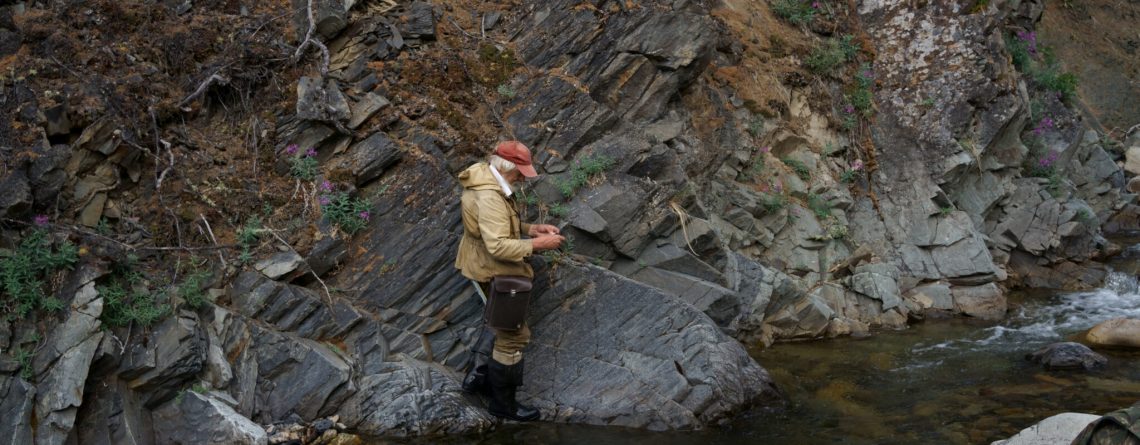
“In 2005, my team and I discovered a fairly substantial placer diamond deposit in Yakutia. We were rafting down the Tyung River, taking samples, and found a section of the river with a fairly high concentration of diamonds, most of which were large. Over the course of the season, we discovered over 300 crystals, including three very large ones, about 8 millimeters in diameter. I found one of them,” says the researcher.
Kolchugin lists the nine most essential items for a field geologist, which are worth checking before heading out on an internship, “A geologist’s main tool is, of course, a geological hammer. It’s needed to break away rock. The second essential item is a field diary, or field book. A compass is, of course, the third item. The fourth is a map (a topographic base), where observation points are plotted and geological bodies are mapped. Of course, various gadgets are now in use, including GPS navigators and tablets. A tablet can be used for both mapping and journaling, but for backup, a regular paper field journal and a compass are still necessary, which are more reliable and sometimes even more accurate than modern instruments and gadgets. Furthermore, many electronic devices won’t be able to measure the position of geological bodies. A compass must be used specifically for this. Since a geologist must observe, record, and sketch, a pencil is needed, and that’s the fifth item. We don’t use fountain pens because if a journal falls into water, the ink will immediately dissolve and the notes will disappear. Pencil writing will be preserved. A protractor is needed for working with a map, drawing the location of bodies, and much more. That’s the sixth essential item. If you plan to work on placer deposits, a shovel or pick is needed. That’s the seventh item. A backpack for storing samples is the eighth item. And number nine is good shoes because you have to walk a lot, and boots are best for that.”