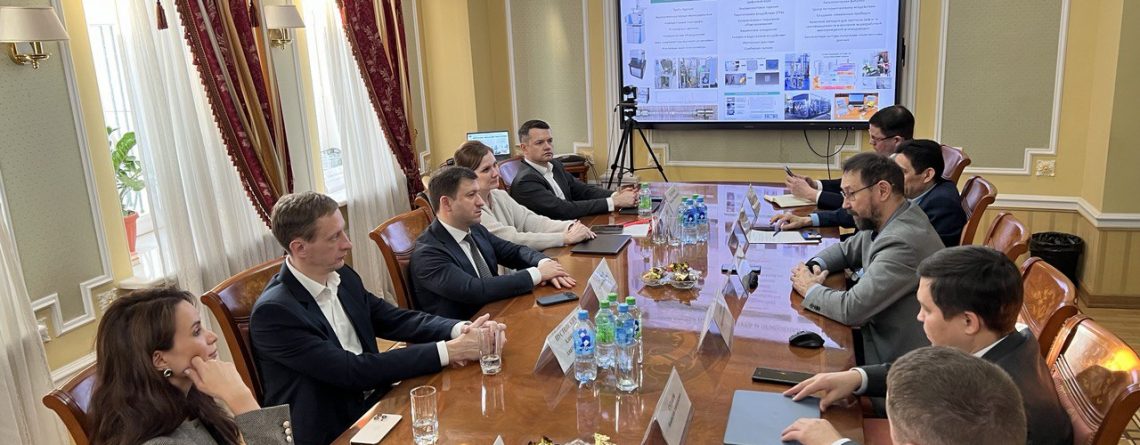
Cooperation development discussed with Gazprom Neft
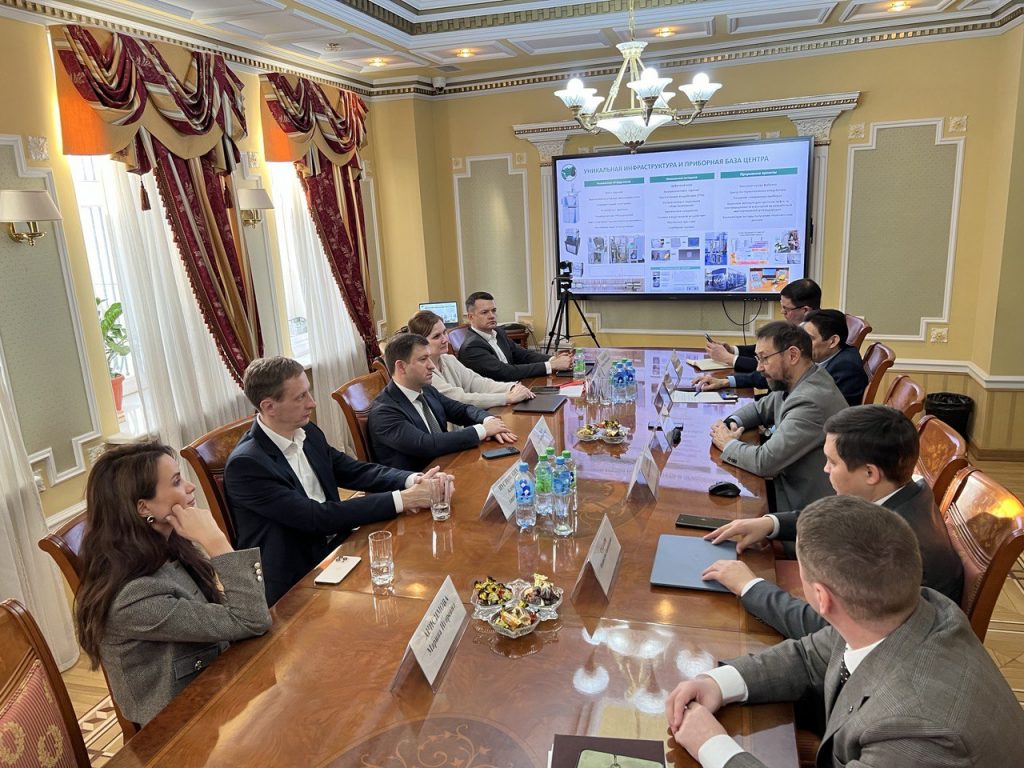
The Institute of Geology and Petroleum Technologies hosted a delegation of Gazprom Neft employees.
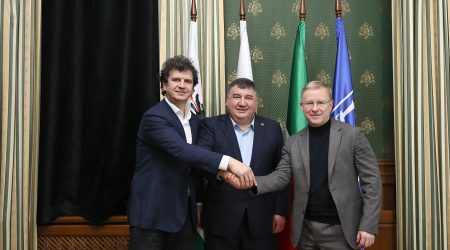
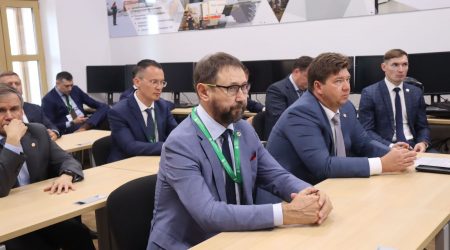
The introduction to the institute began with a meeting between the guests and Danis Nurgaliev, Vice-Rector for Earth Sciences and Director of the Gazprom Neft-KFU Research and Educational Center, along with representatives from the Institute of Geology and Petroleum Technologies: Deputy Director for Continuing Educaion and Work with Industrial Partners, Director of the Center for Advanced Training, Quality Management and Marketing Ildus Chukmarov; Deputy Director for Research Pavel Krylov; Deputy Director for Academic Affairs Andrey Teryokhin; Director of the KFU Technopark of Small-Tonnage Chemical Technologies and Chair of the Department of Petroleum Engineering Mikhail Varfolomeev; Deputy Director for Marketing of the Gazprom Neft-KFU Research and Educational Center Vladislav Sudakov; and Acting Chair of the Department of Geophysics and Geoinformation Technologies Eduard Ziganshin.
Participants in the discussion about cooperation prospects in geological exploration and mineral extraction from Gazprom Neft included: Alexander Sitnikov, Head of the Scientific and Technical Division; Alexey Pustovskikh, Director of Strategy at Nedra Digital; and three employees of the scientific and technical division—Deputy General Director for Expertise and Functional Development Veronika Filimonova, Director of Planning, Reporting and Procurement Efficiency Programs Marina Anisimova, and Head of the Innovation Environment Development Program Mikhail Radzhabov.
Dr Nurgaliev delivered a presentation about KFU and the Institute, noting that the university ranks 35th in the QS world rankings for Petroleum Engineering. Discussing scientific achievements, the Vice-Rector mentioned the Russian Government Prize in Science and Technology awarded in December to Institute representatives for creating and implementing innovative technologies for in-situ oil upgrading and efficient extraction of heavy oil from complex reservoirs. Gazprom Neft employees added that KFU received the company’s Reliable Partnership honorary award last year.
Alexander Sitnikov explained why Kazan University is one of the best partners and what makes it unique, “What distinguishes KFU from our other partners is that the university has built a complete project implementation chain: from idea to product creation, which is then implemented at the company’s facilities. Kazan Federal University is a unique center; it can become the hub for collaboration with our other innovation environment, which we call the Gazprom Neft ecosystem. This ecosystem includes about 50 universities, including KFU – these are our strategic partners. We are now ready to unite partners into clusters for comprehensive solutions to our challenges. And KFU is the platform that can unite other partners around it.”
Drs Varfolomeev, Sudakov, and Ziganshin told guests about projects implemented by the Institute jointly with Gazprom Neft, while Dr Chukmarov focused on additional education programs and developing cooperation in this area.
Vladislav Sudakov emphasized projects in creating digital tools for solving problems in geology and field development.
“We have numerous joint developments with the company’s scientific division in artificial intelligence, and we’ll be implementing these projects for several more years. We agreed to work out a roadmap in more detail for successfully accomplishing what we’ve planned with partners in the Gazprom Neft ecosystem,” he said.
Eduard Ziganshin reported on work performed by staff of the Department of Geophysics and Geo-information Technologies for Gazpromneft-Zapolyarye, a subsidiary of Gazprom Neft.
“We’re using technology developed at our department to assess oil and gas potential in Orenburg Oblast. The technology includes digital elevation model processing and a complex of geophysical and geochemical methods. Preliminary results about the territory’s prospects have been obtained, and laboratory geochemical studies are underway,” he explained.
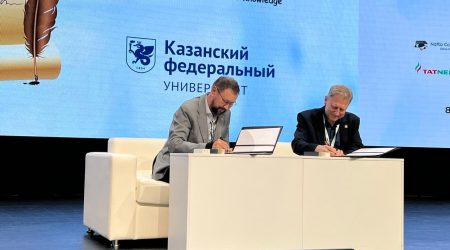
Mikhail Varfolomeev noted that KFU has a long-term framework agreement with Gazprom Neft.
“At the meeting, we discussed projects successfully completed jointly with them. They concern chemical and gas methods for enhanced oil recovery. These are projects related to developing hard-to-recover reserves using supercritical fluids, water influx limitation, injectivity profile alignment, near-wellbore zone treatment, oilfield chemistry, well killing, and hydraulic fracturing. It’s very important for us that products and technologies created within joint work are applied at the company’s fields. We also discussed future projects related to combined enhanced recovery methods and small-tonnage chemistry development. Part of the products being created will be produced on a pilot scale at Kazan University’s engineering center,” he shared after the event.
Ildus Chukmarov reported on expanding cooperation with Gazprom Neft in additional education.
“Our CdoGEO center has long been providing professional development and retraining for Gazprom Neft executives and specialists, including those from its scientific and technical division. We discussed our interaction in creating unique courses based on joint developments by Kazan University and the Gazprom Neft Scientific and Technical Center for the company’s personnel development. Joint course implementation is also planned to promote them in the international market. We’re pleased that our proposals are well-received, and the his colleagues expressed their desire to move forward together in continuing education,” he said.
Representatives of Gazprom Neft’s scientific division visited Institute laboratories and met with young researchers.
“Communicating with Gazprom Neft representatives, we confirmed the correctness of our chosen paths,” noted Vice-Rector Danis Nurgaliev, summarizing the visit. “We now collaborate across several areas, including creating chemistry for enhanced oil recovery and oilfield chemistry, implementing digitalization projects, geology, and additional education. During the visit, company employees paid special attention to digitalization issues, using artificial intelligence to solve various problems, and discussed challenges facing Gazprom Neft. In the evening, our young researchers presented their scientific results and discussed what they plan to achieve in 2026. The guests noted the high level of research and development presented by our young scientists and confirmed their readiness to expand interaction with Kazan Federal University.”