Cooperation avenues discussed with EnviroCells
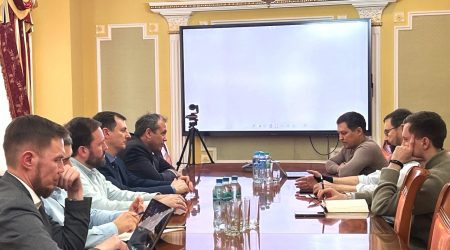
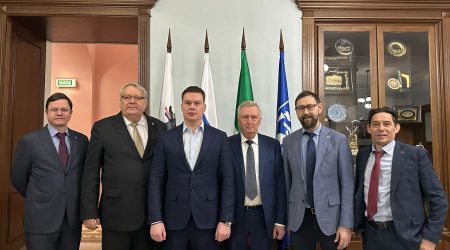
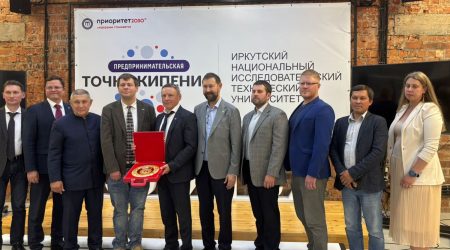
The company’s representatives included CEO Alexey Mironov, Development Director Alexander Bernatsky, and Commercial Director Alzam Nizamutdinov. The university was represented by scientists from two institutes – our own and the Institute of Environmental Sciences.
Presenting the company, founded in 2023, its CEO noted that it is an engineering center of biotechnology, “The first product developed by the company is a xanthan gum synthesis technology. Xanthan produced using this technology has successfully passed laboratory and pilot-scale testing, being used in drilling fluids. We have also developed a number of generic versions of imported starters, and have significant developments in bacterial fertilizers, oil degradants, treatment plant products, human probiotics, and antibodies and probiotics for animals. We know that KFU employs excellent specialists who have all the necessary conditions to conduct scientific research at the highest level. Therefore, we would very much like to establish collaboration with your university.
“We primarily discussed joint scientific research and collaboration with the company in the production of innovative reagents for oil production and the remediation of hydrocarbon-contaminated soils,” said Vice-Rector for Earth Sciences Danis Nurgaliev. “But the prospects for cooperation are much broader. We will not limit ourselves to oil and gas geology. We plan to jointly implement projects in pharmaceuticals and work in other areas. We plan to visit the company in the near future to familiarize ourselves with its capabilities and production facilities.”
Mikhail Varfolomeev, Director of the KFU Small Tonnage Chemical Technology Park, mentioned one possible collaboration.
“The company has developed a biotechnology that enables the production of xanthan, a key chemical used as a component in drilling fluids. This substance also has great potential in other industries; for example, xanthan gum is widely used in the food industry. We are working on technologies for enhanced oil recovery, hydraulic fracturing, and well drilling, where this component holds promise. We plan to produce ready-made compositions based on xanthan and evaluate their effectiveness under various conditions,” he shared.
Associate Professor of the Department of Biotechnology Liliya Biktasheva proposed another option for collaboration with EnviroCells.
“The company has a base for industrial scaling of our developments. We can collaborate in biotechnology, specifically the production of microbial bio-preparations for agriculture,” she explained.