Alfis Gizatullin: “During my summer internship in Kamchatka I understood that I wasn’t wrong in choosing a profession”
Rocks brought back from Koryakia will not only serve as a reminder of his journey to Russia’s eastern borders but will also form the basis for the bachelor’s thesis for the student.
In July and August, the geology student completed an internship at a gold mining company operating in Kamchatka Krai, near Olyutorsky Bay in the Bering Sea.
“Along with other company employees, I was conducting lithogeochemical prospecting for minerals using secondary dispersion halos. Simply put, we were looking for anomalous concentrations of chemical elements in the weathering crust and loose sediments, which are traces (halos) of ore bodies hidden at depth. It was necessary to identify promising areas for further, more detailed exploration,” Alfis says.
He noted that the knowledge he acquired in mineralogy and petrography at the university was very useful.
“All our work was aimed at finding signs of gold. We followed pre-planned routes that cut through various geological structures,” explains the young man. “My task was to describe rock outcrops and collect samples. I collected samples of loose sediments (mainly stream bottom sediments and concentrates, and less frequently, soil layers) along a predetermined grid. I filled out a field tag for each sample. It indicated the sample number, the GPS coordinates of the location where it was collected, as well as the type, nature of the rock, and date. All data was recorded in a field diary. In the evening, office work began in camp. I prepared the samples for further analysis: drying, crushing large fragments, grinding the material into a uniform powder, and packing them into labeled paper bags.”
The area where Alfis Gizatullin worked made a huge impression on him.
“The nature of the Kamchatka Krai is unique. Although I didn’t see any volcanoes during my internship, the breathtakingly beautiful high hills, tundra, and volcanic formations—all of this, of course, was etched in my memory. As a geologist, I was very interested in observing the outcrops of volcanic rocks, which are potentially ore-bearing. I remember the areas with hydrothermal activity—altered silicified rocks—which are a clear sign of potential mineralization,” the interviewee shares.
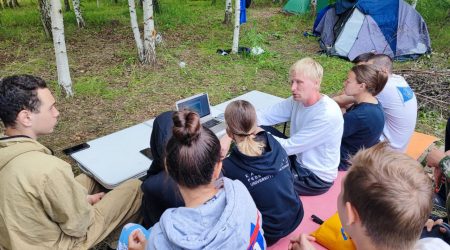
Gizatullin, along with employees of a gold mining company, lived in tents far from civilization.
“The main difficulty was the distance from populated areas and complete autonomy. We had satellite communications, which was only used for business purposes,” the student recounts. “The weather in Koryakia is very capricious. Thick fogs, strong winds from Olyutorsky Bay, and rain could disrupt the work route. Plus, we constantly had to be mindful of bears; they were lurking nearby, so safety regulations in the camp and along the route were strictly observed.”
Alfis recounted his encounter with a bear, which he didn’t even notice at first.
“It was in the second half of July. As we were returning from the route, my partner, who was walking behind me, shouted, ‘Stop! Where are you going? There’s a bear!’ Meanwhile, the bear saw me and began to creep up quietly; the distance between us was now 20-30 meters. It would have taken the bear four or five leaps to catch up with me. My partner pulled out a kind of scarecrow and fired a couple of shots into the air. Then, in a matter of seconds, the bear climbed a 15-meter-high slope with an outcrop and began watching us. We decided not to tempt fate and hurried back to our tent camp,” he said.
The difficulties he encountered didn’t faze the intern.
“After visiting Kamchatka Krai, I realized I had made the right choice of profession. Geology isn’t just about the romance of travel, but also about serious work that requires endurance, attention to detail, and deep knowledge. This summer, I gained invaluable field experience in one of Russia’s most unique regions,” says Alfis. “I learned to visually identify rocks and honed my skills with a topographic map and GPS.”
Alfiz mentions he has been interested in Earth sciences since childhood.
“I chose geology because I dreamed of turning travel into my profession. After entering KFU, I realized I wanted to be not just an armchair scientist, but a true geologist—one who constantly uncovers the planet’s secrets,” he admits.