Associate Professor Dinara Miftakhutdinova wins Tatarstan Award for Young Scientists
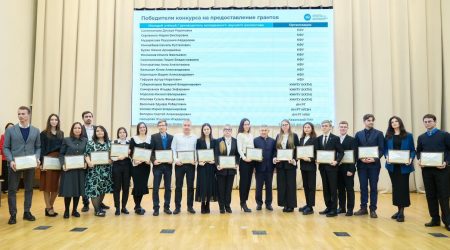
The award is presented to young researchers conducting research in the most promising and significant areas of science and practice for the socioeconomic development of the Republic of Tatarstan.
Dinara Miftakhutdinova’s research is titled Ichnofacies Study of Devonian and Carboniferous Oil-Bearing Terrigenous Deposits of the South Tatar Arch and Adjacent Territories as a Tool for Reconstructing Sedimentation Environments and Basin Evolution.
“I began working on this topic five years ago, when I was studying the biogenic textures of rocks from the Great Permian Extinction interval in the Sakha Republic (Yakutia),” says the geologist. “In the core repository of the Institute of Geology and Petroleum Technology, Vladimir Silantyev, Chair of the Department of Paleontology and Stratigraphy, who was my supervisor, drew attention to the diverse textures of rocks in the Devonian oil-bearing interval. We were fortunate that Tatneft supported our interest and provided the opportunity to study well core in their core repository.”
As the awardee explained, in recent decades, ichnofacies analysis has become an indispensable tool in the study of oil and gas fields worldwide. This is the name given to the method for studying ichnofossils – traces of the life activity of fossil organisms. Ichnofossils are preserved in sedimentary rocks as biogenic structures, such as traces of movement, feeding, burrows, and tunnels. They are especially important in studying the sedimentary environments of objects where traditional fossil remains are absent or poorly preserved, which is often the case in terrigenous strata. Ichnofossils provide scientists with information about the behavior of organisms, their living conditions, and environmental characteristics.
“The Devonian and Carboniferous terrigenous rocks of the South Tatar Arch contain more than half of the total oil deposits and are the main production target for the oil-bearing sediments of the Republic of Tatarstan. Moreover, most of the fields are in the final stages of development. The introduction of new technologies for geological study of deposits, clarifying stratigraphic subdivision, and geological modeling of sediments will extend the life of the fields,” the paleontologist said.
In Russia, ichnofossils, she noted, have already been widely used in the study of oil-bearing sediments in Western Siberia. And for the Devonian and Carboniferous terrigenous deposits of the South Tatar Arch, an ichnofacies analysis was conducted for the first time by a group of scientists from Kazan University.
“Ichnofacies studies allowed us to identify geologically interesting rock intervals that had been studied using other methods,” summarized Miftakhutdinova. “In particular, geochemical studies of several promising intervals of Carboniferous deposits revealed anomalous contents of rare and rare earth elements. A detailed study of oil source rocks at the Devonian-Carboniferous boundary interval revealed thin layers of volcanic tuffs and zircons from them. As a result, radiometric dates were obtained for the first time for this stratigraphic boundary in the Volga-Ural petroleum province.”
Dinara Miftakhutdinova plans to further develop microichnofacies analysis methods to establish the relationship between bioturbation (the mixing of sediment by organisms living within it) and changes in the reservoir rock properties.