Vice-Rector Danis Nurgaliev opens Museum-Laboratory of Natural Sciences at Qayum Nasyri Secondary School
Kazan Federal University co-organized the 5th International Scientific and Practical Conference Nasyri Readings.
The event, which took place at Nasyri Secondary Tatar-Russian School No. 80 with Advanced Study of Selected Subjects (Kazan), was organized by the Ministry of Education and Science of the Republic of Tatarstan and the Education Department of the Kazan Executive Committee.
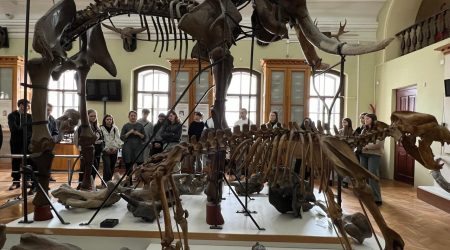
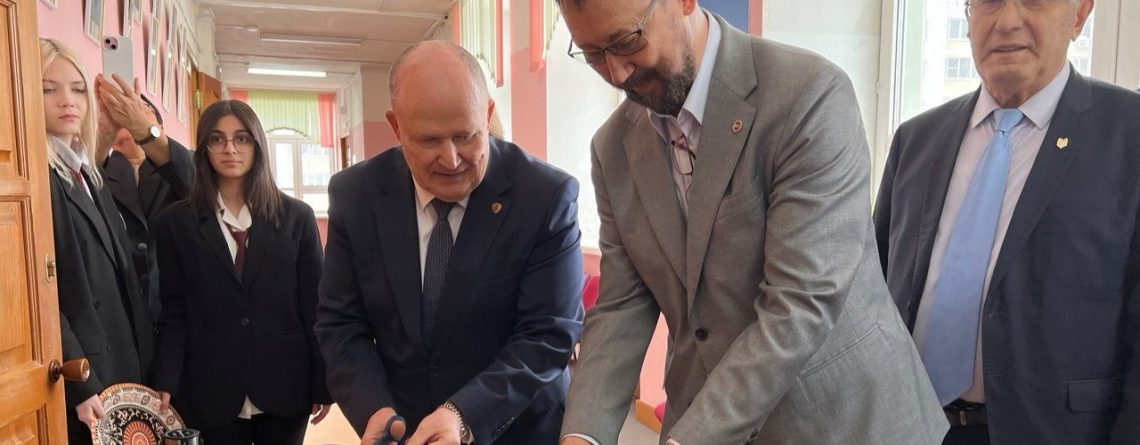
The key event of the conference was the opening of a natural science museum-laboratory at the school, some of whose exhibits, primarily minerals, were donated by KFU. The honor of cutting the red ribbon was granted to Danis Nurgaliev.
He promised that Kazan University will replenish the museum-laboratory with new exhibits and books essential for the younger generation.
“I am very pleased that such a museum has opened at the school.We live in a large country with abundant natural resources. Children should know about them. I believe Tatarstan should become a pilot region for teaching geology in schools,” he said during the ceremony.
Conference participants were also shown the recently opened interactive museum and laboratory of Qayum Nasyri and told about the rich legacy of the polymath, educator, and teacher, whose name is given to the school – one of the oldest in the capital of Tatarstan.
“We work very closely with Kazan University – its institutes and departments. I would like to thank the university from the bottom of my heart for its ongoing support,” said Principal Robert Mansurov during a tour of the school.
Speaking at the plenary session, Dr Nurgaliev noted that Qayum Nasyri is like Pushkin and Lomonosov rolled into one.
“A wonderful book, The Galaxy of Qayum Nasyri’s Teachings, was published for the conference. It contains papers not only from teachers and scholars, but also from children. I believe there is nothing more valuable than raising a child who strives to do something good for people and for the country,” he emphasized.
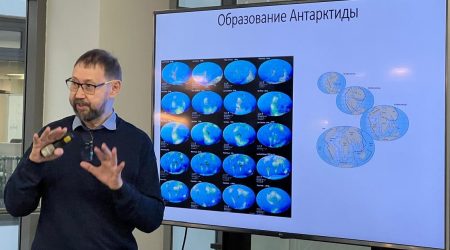
The meeting also featured presentations by Ruslan Ulengov, Head of the Department of Theory and Methodology of Geographical and Environmental Education at our institute, and Professor Ilgizar Gaisin.
“Our department has been co-organizing the conference for the third year,” Ulengov explained. “This year, third- and fifth-year students from the institute presented their papers in the section Ecological and Geographical Education for Secondary School and University Students. Three foreign universities – Bukhara State University, Osh State Humanitarian and Pedagogical University, and Abai Kazakh National Pedagogical University, with which Kazan University collaborates, served as partners.”
According to Dr Gaisin, School No. 80 is a school where university students undertake internships, “This is not the first time our students have participated in this conference. The level of their presentations improves every year, which means our work is not in vain. I was very pleased to learn about the research results of third-year students Elizaveta Prudnikova and Anna Savelyeva. The former’s paper was titled The Evolution of Geological Research Methods: From Field Observations of the Early 20th Century to Modern Technologies (Based on Basalt Analysis), and the latter’s was titled Problems of Karst Typology and Positioning of Karst Phenomena in Tatarstan.”
Second-year master’s student of teacher education Yelena Romanova spoke at a section meeting about the use of mapping programs for spatial data visualization, “This is my third time participating in the conference because it’s a good platform for exchanging experiences, ideas, and gaining new knowledge. I’m always impressed by the diversity of topics and the high level of research presented.”