Alexander Gusev awarded 2nd Class Medal for Outstanding Achievements in Cosmonautics
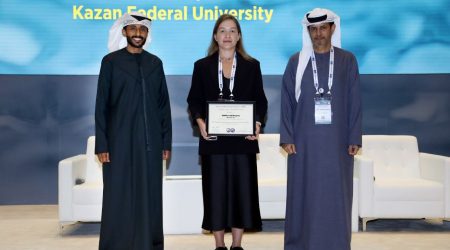
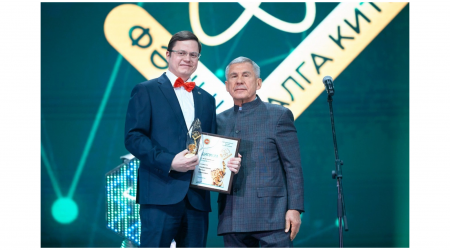
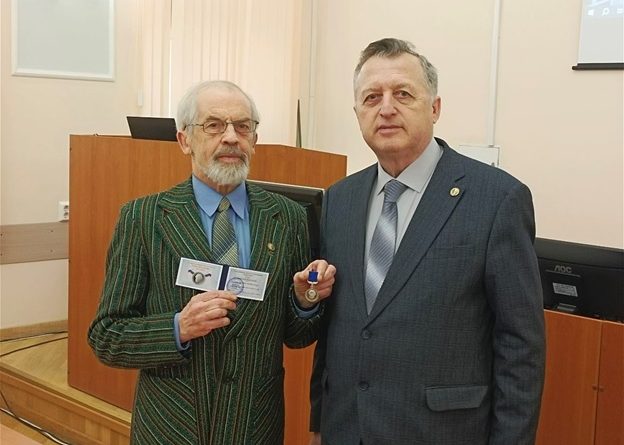
Alexander Gusev, Engineer in the Department of General Geology and Hydrogeology at the Institute of Geology and Petroleum Technologies of Kazan Federal University, has been awarded the 2nd Class medal For Outstanding Achievements in Cosmonautics.
The medal is conferred by the Russian Academy of Cosmonautics.
“Alexander Vasilievich is a full member of the Russian Academy of Cosmonautics. He conducts extensive research on the Moon, carries out a number of state and international projects with scientists from Japan and China, serves as a visiting professor in those countries, takes an active part in the annual scientific readings in memory of Konstantin Eduardovich Tsiolkovsky in Kaluga, and participates in various all-Russian and international scientific conferences on lunar research,” said Vitaly Altunin, President of the Kazan regional branch of the Russian Academy of Cosmonautics.
After the award ceremony, which took place at the organization’s formal meeting, Alexander Gusev delivered a report devoted to the Moon.
“In my talk, I focused on the prospects for industrial development of Earth’s natural satellite. I spoke about joint research projects between Russia and China, and about the creation by Russian scientists of a nuclear reactor to supply energy for future scientific and industrial lunar settlements,” he shared.
Mining of Mineral Resources on the Moon is the title of a course Alexander Gusev offers to KFU geology students. The topic is also the focus of his popular science lectures, which he regularly gives in Kazan and other Russian cities.
“The Moon is rich in mineral resources, including rare-earth metals, which play a key role in a range of industries—from electronics to energy. In addition, unlike on Earth, there are large reserves of helium-3 there (it is often called the fuel of the future),” says Dr Gusev. “However, in developing the Moon, humanity will face a whole set of problems. One of them is solar radiation, which is deadly for humans. To avoid it, those who will be involved in mining on the Moon will have to find or build shelters. In my view, the best option is to use the lava caves that already exist there. How to do this is being actively discussed by Russian and foreign scientists. For Russia to be among the countries that will be the first to begin developing the Moon’s riches, we need to work actively on this topic already now.”