125th anniversary of Yevgeniya Tikhvinskaya, Kazan University’s first female professor
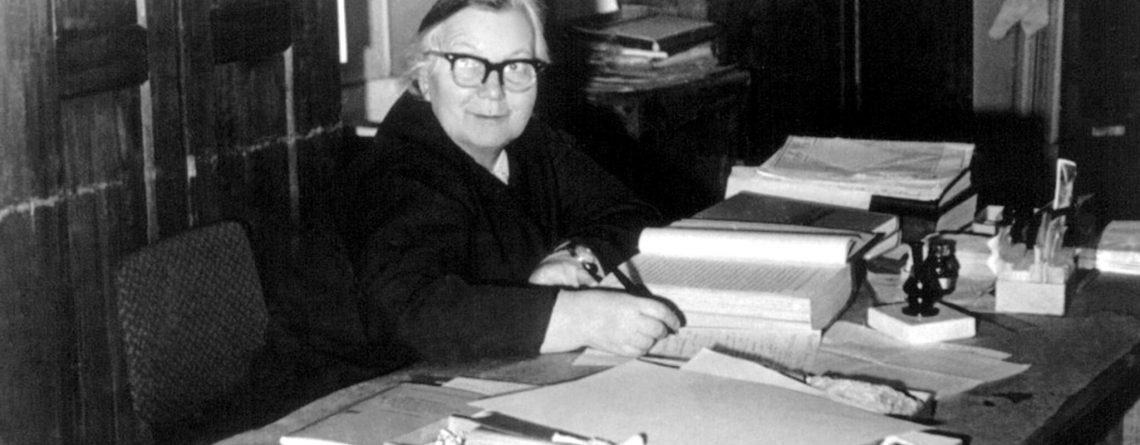
The only female dean in the history of Kazan Unviersity’s geological faculty, who headed it in 1949 – 1953, was born on May 5, 1901.
She also chaired the department of geology from 1934 to 1974.
Yevgenyia Tikhvinskaya’s granddaughter, journalist Maria Gerasimova, a graduate of Kazan University, not only cherishes the memory of her beloved grandmother, who passed away in 1976, but is also writing a book about her.
“My grandmother was born in the city of Vyazma in the Smolensk region,” says Gerasimova. “My great-grandfather, her father, Ivan Tikhvinsky, graduated from a theological academy and taught ancient languages, Russian, literature, and psychology. My great-grandmother, her mother, Lyubov Kochurova, also taught Russian and literature, as well as history. In 1902, the entire family moved to Riga, where they lived until the start of World War I. In 1915, the Tikhvinskys moved to Nizhny Novgorod, where she graduated from a girls’ gymnasium in 1918. To enter university, a certificate from a boys’ gymnasium was required, so my grandmother took the boys’ gymnasium exams, and with flying colors. She received a gold medal.”
From 1918 to 1924, E. Tikhvinskaya studied geology at the Physics and Mathematics Department of Kazan University. In 1925, she entered graduate school under the university’s only professor of geology at the time, Mikhail Noinsky, who also supervised Nikolai Gerasimov, her future husband.
“My grandfather was three years older than my grandmother. They began dating, then married, and had three children – two sons and a daughter. The eldest son, Indrik Tikhvinsky, followed in his parents’ footsteps and became a scientist, earning a doctorate in geological and mineralogical sciences. Their daughter, Natalya Tikhvinskaya, was an actress. The youngest, my father, Nikolai Gerasimov, was a biologist, working first in the biology department and then at the Kazan University History Museum,” said Maria Gerasimova.
Mikhail Noinsky, according to her granddaughter, long believed that Tikhvinskaya could become an accomplished scientist, even though she had already begun independent fieldwork on Permian deposits in the eastern part of Tatarstan, as well as in northern Bashkortostan, the southern Perm and Kirov regions, and near Kazan, in the summer of 1923.
In 1929, Tikhvinskaya became an assistant lecturer in the Geology Department, and five years later (after the death of Noinsky), she became the department’s head. In 1938, she was awarded a candidate of science degree without defending a dissertation. This was the result of her significant scientific and professional achievements. Her doctoral dissertation, defended in 1943, was entitled Stratigraphy of Permian Red Beds in the Eastern Russian Platform. In 1944, she was promoted to full professor.
Tikhvinskaya conducted research in regional geology, stratigraphy and paleogeography, petroleum geology, and the history of science. She authored approximately 80 scientific papers, including five monographs.
Her stratigraphic constructions were always based on a thorough study of rock materials, a detailed layer-by-layer study and analysis of sections, accompanied by spatial tracing of individual layers and units, which allowed her to identify their occurrence conditions and the nature of their facies variability. From comparing sections in individual regions, Tikhvinskaya moved on to correlating stratigraphic schemes over a vast territory, then proceeding to reconstruct paleobiogeography and the history of tectonic structure development. Her research was always based on the historical-geological method, the foundations of which were laid by her teacher, Professor Noinsky. Developing his ideas, Tikhvinskaya was the first to apply the stratigraphic method to the subdivision of red-bedded sediments of the Permian system, combined with the principle of sedimentation cycles and analysis of basin salinity changes. In subsequent years, this approach became widespread in the study of red-bedded strata of various ages in other regions,” writes Vladimir Silantyev in the article A Scientist and the Kazan University Scientific Notes: Professor of Geology Yevgeniya Tikhvinskaya.
Her research made an important contribution to substantiating the oil-bearing potential of the territories of Tatarstan and Bashkortostan. She played a key role in the discovery of the gigantic Romashkino oil field. As early as 1934, under her leadership, a group of geologists first mapped the Romashkino uplift, a structure promising for oil exploration.
Her work for the good of the country was recognized with the Order of the Red Banner of Labor, the Badge of Honor, and medals. She was an Honored Scientist of the Tatar Autonomous SSR and an Honored Oil Worker of the USSR.
“Grandma’s office was a large room divided in half by a closet. There was a sofa, a large Chinese carpet with flowers hanging above it, and a desk nearby, where she would work for long periods under a lamp. She was always surrounded by numerous books on geology, various maps, and a copy of the Big Soviet Encyclopedia. Rock samples were scattered throughout our home. I still keep some of those stones,” recalls Maria Gerasimova, who lived with her parents and grandmother.
According to her granddaughter, Tikhvinskaya was a very sociable and hospitable person: her colleagues and PhD students were constantly visiting their home, as were geologists from various cities. It’s important to note that all 47 people who wrote their PhD dissertations under her supervision successfully defended them.
“Grandma’s friends, including those from other cities, would come to the dacha in Ilyinka, where we, grandchildren, were sent for the entire summer. A large group would gather there on weekends – up to thirty people. These were grandmother’s relatives, friends, and colleagues,” recalls Gerasimova. “We would always go into the forest with a large group to pick mushrooms and berries, or to swim in the river. Grandma, who loved nature, would tell the children about plants, animals, and rock formations during these walks, and show them springs. She taught us how to navigate the forest and how to behave properly in nature.”
Tikhvinskaya was not only an intelligent person, but also a very kind and responsive person. She enjoyed unquestioned authority not only in the family but also among her colleagues, which is probably why she was trusted to carry out significant community work. In particular, from 1946 to 1958, she was a deputy of the Supreme Council of Tatarstan, and also, at various times, a member of the Presidium of the Central Committee of Trade Unions of Higher Education and Scientific Institutions.
“Grandmother was a charismatic person. People always listened to her words. She spoke calmly, never got nervous, and never dictated to anyone. I was amazed at how she was able to find common ground with everyone: doctors of science and academics, village women, children, and students,” shares her granddaughter.
The Geology Department of Kazan University grew significantly during Tikhvinskaya’s tenure as dean: the Department of Oil and Gas Geology and the Department of Geophysical Exploration Methods were established, along with corresponding new specialties. The number of students increased tenfold: from about 30 to around 300.
“Grandma always had two or three ‘secret scholarship winners’ from among low-income students who had failed their exams and were left without a scholarship,” says Maria. “She supported them financially, giving them a certain amount every month during the semester. And they lived up to expectations – they successfully graduated from university and became excellent geologists, administrators, and teachers at Kazan University.”
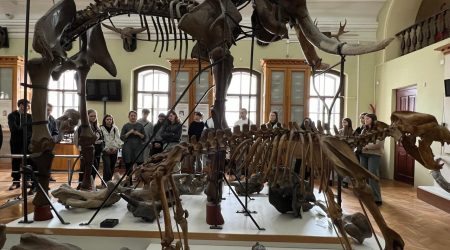
The parareptile Procolophon Tichvinskia vjatkensis is named after Professor Yevgeniya Tikhvinskaya, a leading specialist in Permian deposits. It belongs to the procolophonid group, an extinct suborder of herbivorous reptiles that lived from the Middle Permian to the end of the Triassic period.