Institute holds final stage of secondary school contest in geology and petroleum science
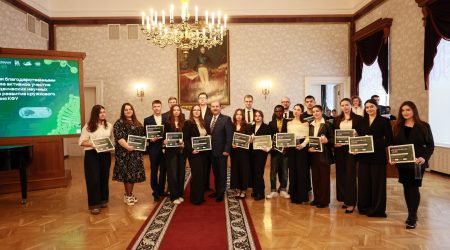
More than 100 Russian school students in grades 5–11 competed in the finals.
“The Olympiad consists of two rounds. The first, qualifying round was held using remote access technologies in November. Students whose work the jury recognized as the best were invited to the final (in-person) round – about 45 percent of all participants,” saidAndrey Teryokhin, Deputy Director for Academic Affairs at IGPT.
He noted that preparing for the Olympiad is not easy, since the subject of geology is not part of the school curriculum, and geology clubs are not available at every school. Nevertheless, interest in it is growing, as evidenced by the number of participants increasing year by year.
“The Institute implements widespread career-guidance work. For example, we run the project called Admission Volunteers. Students who take part visit their former schools and tell schoolchildren about the Institute,” the deputy director explained.
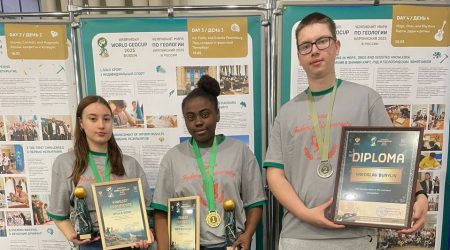
He added that each year the student body is replenished by winners and participants of the Olympiad, sometimes more than 20 of them.
“When applying to Kazan University for the relevant programs, first-placed students of the KFU Interregional Subject Olympiad in geology and oil and gas engineering who are currently in 11th grade will receive 10 additional points added to their Unified State Exam results, and other winners will receive 8 additional points. If the current 11th-graders became winners last year while in 10th grade, they will also receive 10 or 8 points respectively when applying to Kazan University,” said Dilyara Muravyova, Director of KFU’s Center for Work with Gifted School Students.
Sixth-grader and straight-A student Grigory Rozhin took part in the geology Olympiad for the first time.
“I answered almost all of the theoretical questions, but the practical part turned out to be difficult – we were given minerals and had to write down their names,” said the student of Lyceum No. 83 of Kazan.
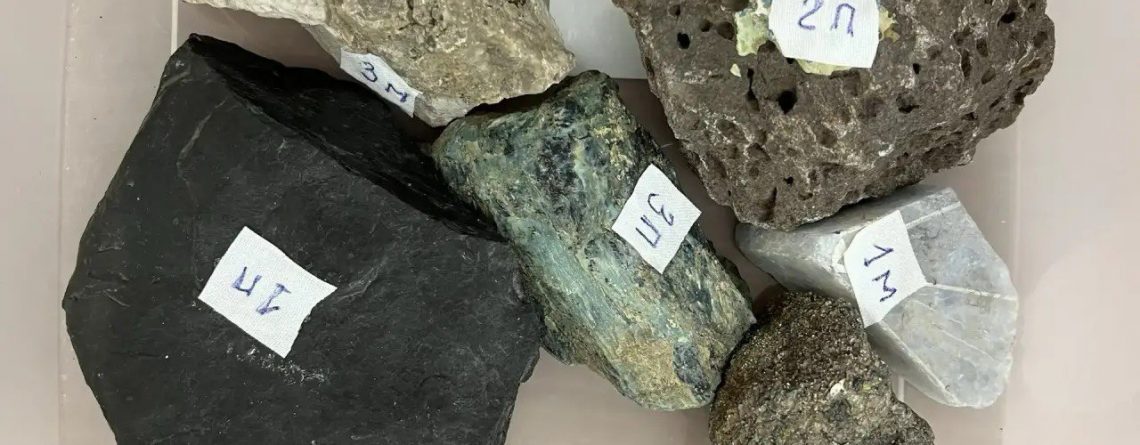
The practical task drew particular interest from many students. They had to identify rock samples and paleontological specimens provided by the Department of Mineralogy and Lithology, the Department of General Geology and Hydrogeology, and the Shtukenberg Geological Museum.
“I study in an engineering class and have previously taken part in various geology Olympiads because I’m interested in this science. I liked that the KFU Olympiad had not only a theoretical part but also a practical one – we were asked to identify rocks and paleontological specimens and write their names in a table. It wasn’t easy. In the future, I would like either to work in information technology or in a laboratory with minerals,” shared Bogdan Burlin, a student of Gymnasium No. 179 in Kazan.
Valeria Khaminova, a student of School No. 1 of Aktyubinsky in the Aznakayevo District of the Republic of Tatarstan, decided to try her hand at the Olympiad for the second time.
“Our school has a geology club that I started attending, and I became very interested in geology. It is led by the geography teacher Zinira Shamshutdinova. Together with her we study different rocks, minerals, and much more,” the 10th-grader noted.
In her view, this year’s tasks were more difficult than last year’s; the theoretical part proved challenging.
“Our main goal is to spark children’s interest in geology and the world around them. Some of them were holding minerals and paleontological specimens in their hands for the first time. There is nothing bad if someone could not identify them correctly. The important thing is that they have questions and the desire to find answers. The real world is far more interesting and beautiful than the virtual one, and this is what we want to show schoolchildren who now spend a lot of time on the Internet. Russia is extraordinarily diverse from a geological standpoint. There is no other country with as many wonderful places as we have,” noted Evgeniya Nurieva, Associate Professor of the Department of Mineralogy and Lithology and head of the Institute’s Young Geologist School.