Master’s students of Complex Data Analysis in Geosciences present graduation theses
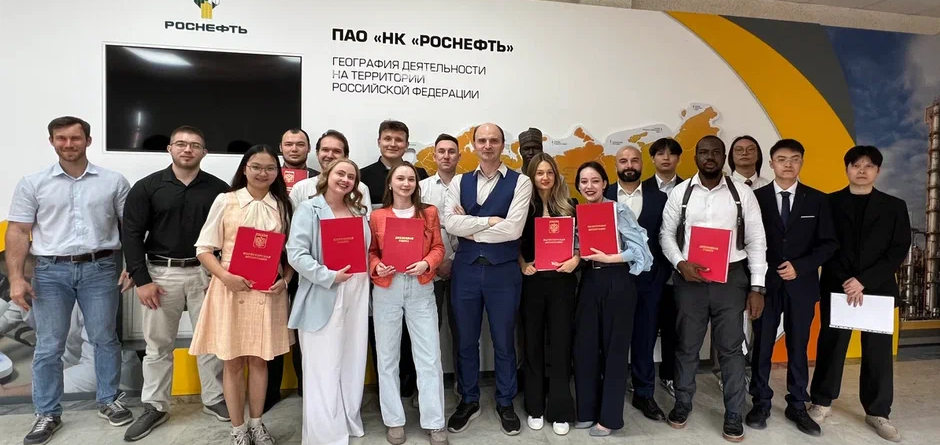
All 16 graduates of the English-language program received excellent grades.
This international program, implemented by KFU, is aimed at training specialists in the interpretation of geophysical data and the construction of geological and hydrodynamic models of oil and gas fields.
“This year’s graduates include representatives of five countries: Russia, the People’s Republic of China, the Federal Republic of Nigeria, the Republic of Niger, and the Syrian Arab Republic,” said Boris Platov, program supervisor and senior lecturer at IGPT. “I would like to note that four master’s students from China will receive dual degrees – one from KFU and one from China University of Petroleum, as their master’s program was a dual degree program.”
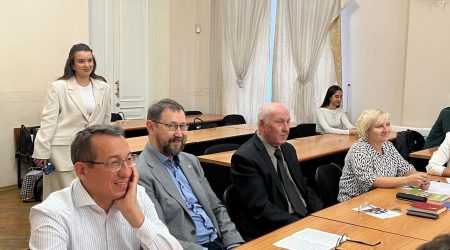
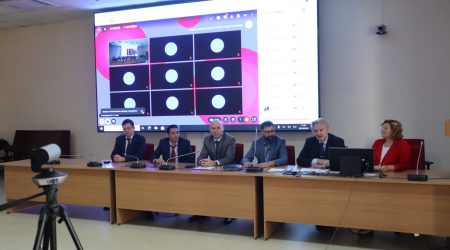
Following the defense of their master’s degrees, Lyudmila Karpova, head of the geological department at Tatneft’s Tatarstan Geological Exploration Department, congratulated the newly graduated students.
“This is my third year serving on the certification committee, and I want to note that the quality of graduates in this master’s program is always high, but this year’s results are especially impressive. For the first time, everyone defended their theses with honors,” she told a journalist. “Tatneft is always happy to hire KFU graduates. More than half of our Tatarstan Geological Exploration Department employees, including myself, graduated from Kazan University. Furthermore, IGPT students from various countries complete internships at our company every year.”
Many of the master’s degree students combined their studies with work, like Agidel Ishberdina from Volgograd.
“I studied at Kazan Federal University on an individualized plan to work for an oilfield services company located in Tyumen. My professional responsibilities include creating digital models of fields and reservoirs. I can say that choosing this program was a perfect fit. I use everything we studied in my master’s program in my work. We taught English well at school, so studying in a foreign language wasn’t a problem for me. On the contrary, it gave me another opportunity for self-development,” she shared.
Ishberdina’s master’s thesis is titled Creation of a Geological Model of the YUS Formation at the N Field in Western Siberia with the Integration of Hydrodynamic Modeling.
Her classmate, Eldar Asbapov from Bashkortostan, works as a geologist at Rosneft. He presented his thesis, Constructing Structural Surfaces of the Tulskian Horizon of the Visean and Tournaisian Stages Based on 3D Seismic Data, Calculating the Porosity Coefficient, and Determining Its Correlation with Seismic Attributes Using a Field in the Republic of Tatarstan as an Example.
“Although my work at the company isn’t directly related to what we studied in the master’s program, I believe that a geologist today should know a lot, including modeling and logging,” he noted.
Mamoudou Boubacar Hamza from Niger informed that he studied at the expense of the Russian Federation’s scholarship for foreign citizens.
“First, I spent two years studying for my undergraduate degree in Cameroon, then in Burkina Faso. After that, I was sent to Russia. At Kazan Federal University, I studied Russian for a year in the preparatory faculty, and then entered the master’s program at the Institute of Geology and Petroleum Technologies. Here I worked on my master’s thesis, entitled Integrated Seismic Interpretation for Paleochannel Identification in a Tatarstan Oil Field: Application of Petrel and IP Seismic Software. I’m very pleased to have successfully defended it. I don’t yet know where I’ll be working after graduation. I’m currently interning at a Tatarstan oil company,” said the student.